
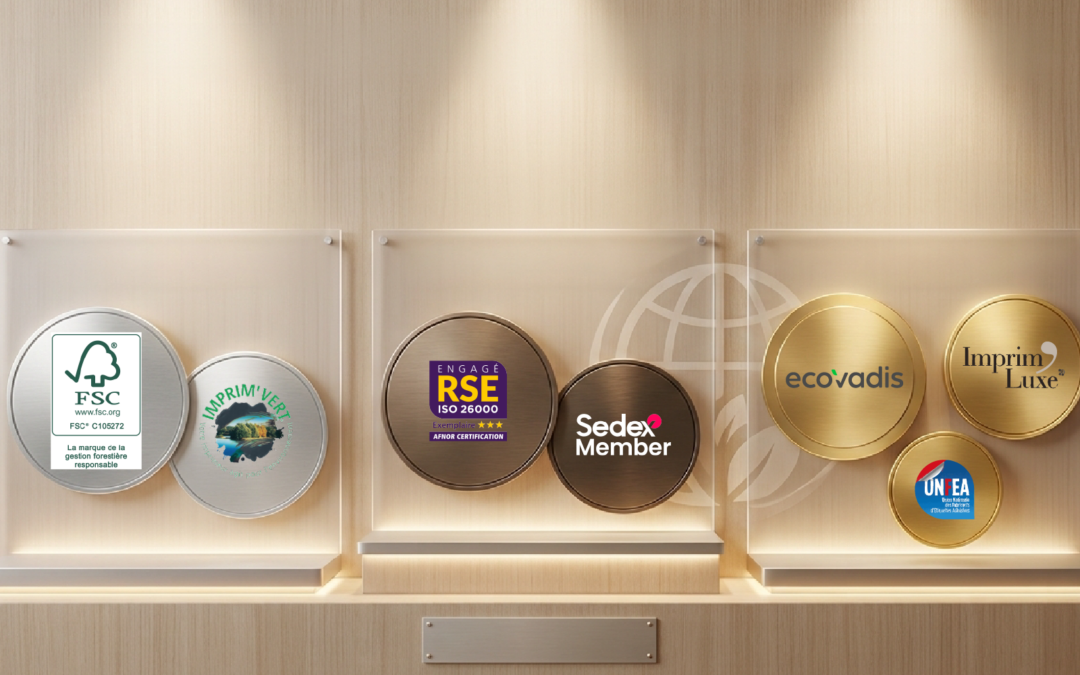
FSC®, Imprim’Vert, AFNOR Engagé RSE, EcoVadis, ISO 12647… On a printer’s website or in a tender document, the logos can quickly start to add up. It is not always easy to make sense of them, let alone understand what each one actually guarantees. At INESSENS, we have chosen not to rely on just one approach. Our printing houses hold several certifications and accreditations because each one addresses a different issue.
Let’s take a closer look at them.
Where does the paper come from, and how does the printing house operate?
FSC®: the origin of materials
FSC® Chain of Custody certification means that the supply chain for certified FSC® products at INESSENS printing houses (ASET, BIDOIT, ROY, DIGIT, HAAS, Art&Sens, EDP and LSP) is traceable throughout. It supports responsible forest management and confirms that the materials used come from responsibly managed FSC®-certified forests, or from recycled or controlled sources. It is part of a wider commitment to responsible sourcing.
The certification is held by ASET, BIDOIT, ROY, DIGIT, HAAS, Art&Sens, EDP and LSP.
Find details of the FSC certifications held by each printing house on their respective website pages.
Imprim’Vert: production practices
This certification focuses on managing the environmental impact of printing activities: waste management, consumables, chemical storage, staff awareness and training, and more. These are practical measures implemented on the production floor, independently assessed and monitored over time, rather than simply statements of intent.
ASET, BIDOIT, ROY, Art&Sens and LSP hold this certification.
Taking a step back: the company’s overall CSR approach
AFNOR Engagé RSE: a comprehensive approach
This is the most wide-ranging approach we have adopted. Based on the principles of ISO 26000, it looks at how CSR is integrated throughout the company: governance, the environment, human resources, responsible purchasing and stakeholder relations. It assesses the overall vision, how the approach is structured, the consistency of commitments and the ability to make continuous improvements.
It applies to INESSENS and all its printing houses.
EcoVadis: an independent external assessment
Widely used by major companies, this assessment awards a rating based on four key areas: the environment, labour and human rights, ethics, and sustainable procurement. It provides an opportunity to assess a company’s CSR performance and benchmark it against market expectations.
ASET, BIDOIT and HAAS are assessed by EcoVadis.
Sedex: transparency throughout the supply chain
Here, INESSENS is positioned as a supplier. The platform allows companies to share information transparently about their social, ethical and environmental practices. It helps strengthen transparency and risk management throughout the value chain.
ASET, BIDOIT and DIGIT are members, while the process is currently under way for Art&Sens and LSP.
Expertise and know-how
The next four are slightly different. They are not strictly CSR labels. Instead, they recognise professional expertise and operational excellence, while contributing to the quality, reliability and trust that customers place in a company.
Imprim’Luxe: recognised printing expertise
Imprim’Luxe recognises the expertise of companies specialising in high-end printing. It reflects the demanding standards of the luxury sector, outstanding production quality and French craftsmanship.
ASET holds this label.
Qualétiq: a structured approach to continuous improvement
Qualétiq is a somewhat hybrid approach. It is not a CSR label, but combines quality, organisation, environmental responsibility, risk management and continuous improvement. It reflects a company’s ability to structure its operations and continually improve its practices over time.
This approach is implemented at HAAS.
ISO 12647: colour management and print quality
ISO 12647 is a technical standard relating to colour management and print quality. Colour accuracy, consistency from one print run to the next, fewer errors and less reprinting: it helps ensure reliable, consistent results through controlled production processes.
ASET holds this certification.
ISO 22716: Good Manufacturing Practices for cosmetics
Finally, ISO 22716 is the standard for Good Manufacturing Practices (GMP) in the cosmetics industry. Again, this is not a CSR certification, but rather a rigorous manufacturing framework covering process control, traceability, safety and compliance with industry standards.
It is an asset for HAAS, whose production serves this market.
Each label answers a different question
None of these approaches is sufficient on its own. Some provide guarantees about the origin of materials, others focus on environmental practices, production quality or the company’s overall CSR approach.
It is precisely this complementarity that creates value for our customers. Behind every logo lies a concrete answer to a legitimate question that deserves to be asked before entrusting a printing project to a supplier.
In a nutshell:
| Certification or scheme | The key question it answers |
|---|---|
| FSC® | Do the materials used come from responsibly managed sources? |
| Imprim’Vert | How does the printing house manage the environmental impact of its activities? |
| AFNOR Engagé RSE | How does the company integrate CSR into its day-to-day operations? |
| EcoVadis | How does the company measure up against market expectations and other businesses? |
| Sedex | Is the company transparent about its social, ethical and environmental practices? |
| Imprim’Luxe | Does the company have recognised expertise in demanding markets? |
| Qualétiq | Is the company well organised and committed to continuous improvement? |
| ISO 12647 (Colour management) | Are colour quality and consistency properly controlled? |
| ISO 22716 (Good Manufacturing Practices) | Do products intended for the cosmetics industry comply with Good Manufacturing Practice requirements? |