
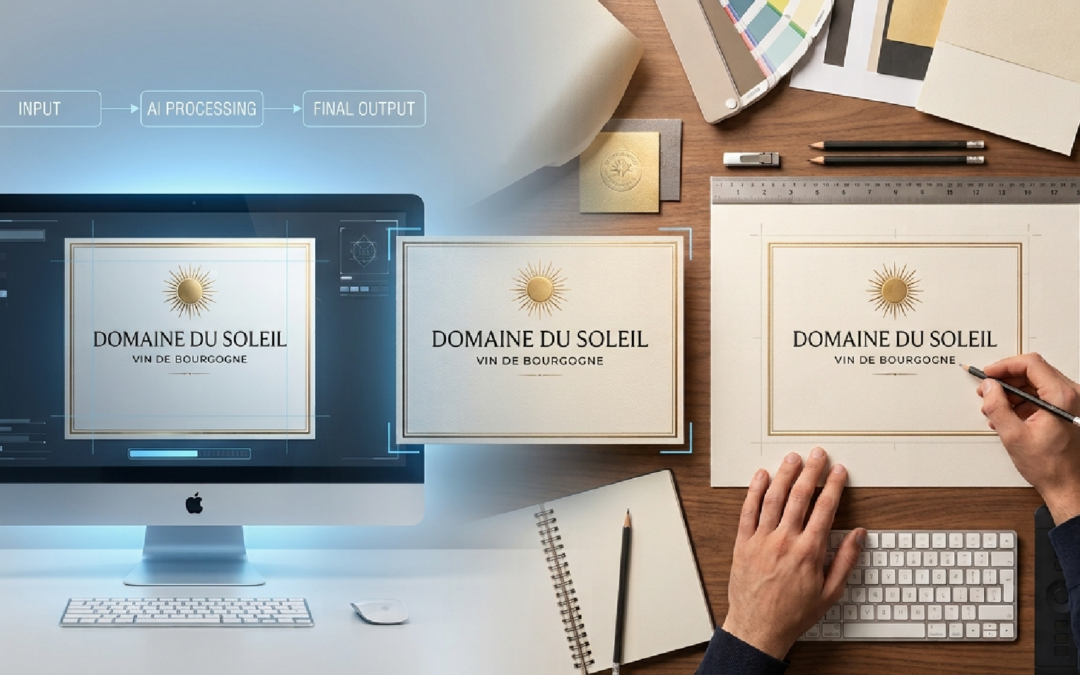
What if imperfection became the new luxury in the age of artificial intelligence?
Perfect images, optimised copy, instant creativity… AI is transforming the creative industries at an unprecedented pace. In a matter of seconds, it can generate visuals, concepts, content and entire brand worlds. This revolution is opening up remarkable opportunities for productivity and innovation.
Yet, as content becomes ever more abundant and increasingly standardised, an opposing trend is emerging: a growing desire for authenticity, materiality and genuine emotion.
AI accelerates creativity… but can also homogenise it
Never has it been easier to produce creative content. Visual identities can be developed in just a few clicks, and label designs can be generated at remarkable speed.
However, this ease comes with a potential downside: outputs can begin to look strikingly similar. Compositions are flawlessly balanced, colour palettes perfectly harmonised, and every detail meticulously refined.
In the world of packaging, this can result in ultra-polished designs, impeccably smooth finishes and creations so perfect that they risk becoming impersonal.
For brands, the danger is losing the very thing that makes them distinctive: their character.
Imperfection is becoming desirable again
In response to this growing uniformity, consumers are increasingly drawn to products that feel genuine, alive and sincere.
Hand-drawn illustrations are making a strong comeback on wine and spirits labels. Handwritten or intentionally irregular typography appeals through its authenticity. Natural textures, uncoated papers and tactile materials reintroduce an emotional dimension that digital technologies still struggle to replicate.
Even subtle printing variations, once regarded as flaws, are now sometimes celebrated as marks of authenticity.
Just as in wine and perfumery, emotion often lies in nuances and irregularities that cannot be perfectly reproduced. These are the details that tell a story and create a meaningful connection with consumers.
This search for authenticity also explains the growing popularity of limited editions, numbered series, personalisation through randomly generated variable data, and designs that celebrate local craftsmanship and long-established print houses.
Print: a tangible response to digital saturation
In a world where screens are ever-present, print is reclaiming an essential role: offering a genuinely tactile experience.
Packaging becomes a physical point of reference in an increasingly virtual environment. It allows consumers not only to see, but also to touch.
The raised texture of embossing, the subtle elegance of sculptured embossing, the brilliance of foil stamping, the depth of thermography and the visual impact of tactile varnishes all create an immediate sensory experience. Simply picking up a bottle becomes a meaningful interaction with the brand.
Textured papers and innovative substrates further enhance this emotional connection. At Inessens, we are seeing growing demand for materials that engage multiple senses simultaneously : not only sight, but touch as well.
Techniques such as micro-embossing create subtle textures and relief effects that naturally encourage consumers to pick up and explore the product.
Beyond aesthetics, print offers something that digital experiences cannot fully replicate: physical sensation.
The future is not AI versus humans, it is AI enhanced by human emotion
Framing artificial intelligence and human creativity as opposing forces would be a mistake.
AI is an extraordinary tool for exploration, acceleration and creative development. It enables teams to save time, test more ideas and explore entirely new creative directions.
But emotion, intuition, sensitivity and the ability to forge genuine human connections remain uniquely human qualities.
For premium brands, the challenge will not be choosing between technology and authenticity, but finding the right balance between the two.
In a world where almost anything can be generated in seconds, true luxury may soon lie in creations that still bear the unmistakable imprint of the human hand.
Atelier 7 is an independent creative and communications agency. Its team brings together talented designers, all trained in our latest innovations as well as our specialist printing techniques. Whether you are creating a new brand, developing a concept or designing premium packaging, Atelier 7 provides expert guidance to ensure your project is innovative, technically achievable and perfectly aligned with your budget.